The 10 Most Powerful Production Cars in the World: A Deep Dive into Automotive Extremes
In the never-ending quest for speed and performance, the automotive industry consistently pushes the boundaries of what’s possible. For over a decade, we’ve witnessed the rise of hybrid hypercars, the refinement of forced induction, and the quest for that elusive title: the most powerful production car. While names like Bugatti, Ferrari, and McLaren often dominate the conversation, the landscape of automotive excellence is constantly shifting. In 2025, with the latest technological advancements and homologation requirements, the hierarchy of horsepower has evolved once again.
This comprehensive analysis delves into the world’s most potent road-legal machines, exploring the engineering marvels that redefine performance. We’ll examine the power figures, technological innovations, and market dynamics that place these vehicles at the pinnacle of automotive achievement. Whether you’re a dedicated petrolhead, an industry analyst, or simply fascinated by the pursuit of the ultimate driving machine, this guide offers an in-depth look at the kings of the horsepower crown.
What Defines a “Production Car”?
Before diving into the list, it’s crucial to understand the criteria that separate these titans from one-off concepts or bespoke race builds. The term \”production car\” generally refers to a vehicle manufactured in series for sale to the public. However, the specific definition can vary, often hinging on the number of units produced.
Historically, manufacturers needed to build a minimum number of vehicles to qualify for motorsport regulations (e.g., 500 units for Group B rallying). Today, the line is often blurred by \”homologation specials\”—cars built in extremely limited runs (sometimes as low as 30 units) to meet specific market or racing requirements.
For the purpose of this list, we consider cars that are:
Road-legal: Equipped with features necessary for public road use (lights, emissions controls, safety equipment).
Mass-produced (relatively): Manufactured in numbers greater than a typical one-off custom build, usually exceeding 10 units.
Available for purchase: Not exclusively reserved for a manufacturer’s internal use or a single client.
It’s important to note that the hypercar market operates differently from the mainstream automotive industry. Production numbers are often intentionally low to maintain exclusivity and value, with many models selling out before they even hit the production line.
The Reigning Champion: Bugatti Chiron Super Sport 300+
For years, the Bugatti Veyron 16.4 Super Sport held the title of the world’s most powerful production car. However, in the relentless pursuit of automotive supremacy, Bugatti itself has surpassed its previous achievement. The current king of the horsepower crown is the Bugatti Chiron Super Sport 300+.
While the standard Chiron boasts an already astronomical 1,500 horsepower, the Super Sport 300+ takes this figure to a new stratosphere. Thanks to extensive modifications including enlarged turbochargers, a revised exhaust system, and optimized airflow, this quad-turbocharged 8.0-liter W16 engine produces a staggering 1,600 horsepower (1,176 kW).
The \”300+\” in its name refers to its historic achievement of being the first production-based car to break the 300 mph barrier, reaching a verified top speed of 304.77 mph (490.48 km/h) in 2019. Although this specific run was conducted in a pre-production prototype, the production models, limited to just 30 units, retain the same powertrain and aerodynamic package, making them the most powerful road-legal cars ever produced.
Key Specifications:
Engine: 8.0-liter Quad-Turbocharged W16
Horsepower: 1,600 hp
Torque: 1,600 Nm (1,180 lb-ft)
0-60 mph: 2.3 seconds
Top Speed: Electronically limited to 273 mph (440 km/h), though capable of much higher speeds
The Chiron Super Sport 300+ isn’t just about raw power; it’s a masterclass in engineering. Its carbon fiber monocoque chassis, adaptive aerodynamics, and advanced thermal management systems ensure that this immense power is delivered with precision and control. The interior, while luxurious, is driver-focused, with exposed carbon fiber and high-quality materials that underscore its performance pedigree.
The Hybrid Titans: The New Era of Automotive Power
The automotive landscape has been irrevocably changed by the integration of electric powertrains. In 2025, the most powerful cars on the road are no longer purely internal combustion machines. Hybrid systems, combining the raw power of gasoline engines with the instant torque of electric motors, have enabled manufacturers to achieve previously unimaginable power outputs while also improving efficiency and reducing emissions.
Ferrari SF90 Stradale: The Benchmark Hybrid
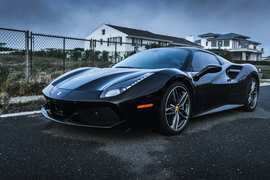
Ferrari’s first series-production plug-in hybrid, the SF90 Stradale, redefined what a hybrid hypercar could be. Named in honor of Ferrari’s 90th anniversary and the 2019 F1 car, the SF90 combines a mid-mounted twin-turbocharged V8 with three electric motors.
The result is a combined output of 986 horsepower (735 kW), delivered through an advanced all-wheel-drive system that provides exceptional traction and handling. The SF90 can operate in pure electric mode for short distances, showcasing its versatility, but it truly excels when all systems are engaged, delivering blistering acceleration and track-ready performance.
Key Specifications:
Engine: 4.0-liter Twin-Turbo V8 + 3 Electric Motors
Horsepower: 986 hp
Torque: 800 Nm (590 lb-ft)
0-60 mph: 2.5 seconds
Top Speed: 211 mph (340 km/h)
McLaren Speedtail: The \”Hyper-GT\”
McLaren’s answer to the hybrid hypercar race is the Speedtail, a spiritual successor to the iconic McLaren F1. What sets the Speedtail apart is its unique three-seat configuration, with the driver positioned centrally, flanked by two passenger seats.
While its power output might seem modest compared to the Chiron, the Speedtail’s focus is on high-speed cruising rather than outright track dominance. Its twin-turbo V8 hybrid system produces a combined 1,036 horsepower (772 kW), enabling a top speed of 250 mph (403 km/h). The Speedtail’s lightweight carbon fiber construction and advanced aerodynamics make it one of the most efficient high-performance cars ever built.
Key Specifications:
Engine: 4.0-liter Twin-Turbo V6 Hybrid
Horsepower: 1,036 hp
Torque: 1,150 Nm (848 lb-ft)
0-60 mph: 2.8 seconds
Top Speed: 250 mph (403 km/h)
The V12 Legends: Natural Aspiration at its Finest
While forced induction and electrification continue to dominate the headlines, the traditional V12 engine remains the benchmark for many purists. These naturally aspirated powerhouses offer a unique driving experience characterized by their linear power delivery, intoxicating sound, and mechanical purity.
Lamborghini Revuelto: The Electrified V12
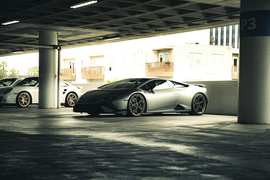
Lamborghini’s flagship model, the Revuelto, represents the perfect marriage of V12 tradition and hybrid innovation. Replacing the iconic Aventador, the Revuelto combines a naturally aspirated 6.5-liter V12 engine with three electric motors, resulting in a combined output of 1,001 horsepower (740 kW).
The Revuelto’s all-wheel-drive system and advanced aerodynamics make it the most powerful and fastest production Lamborghini ever created. Its performance figures are nothing short of astonishing, with 0-60 mph achieved in just 2.5 seconds and a top speed exceeding 217 mph (350 km/h).
Key Specifications:
Engine: 6.5-liter Naturally Aspirated V12 + 3 Electric Motors
Horsepower: 1,001 hp
Torque: 725 Nm (535 lb-ft)
0-60 mph: 2.5 seconds
Top Speed: 217 mph (350 km/h)
Ferrari F12 Berlinetta Successor (Conceptual): The Future of V12 Power
While the F12 Berlinetta itself was a masterpiece of naturally aspirated V12 engineering, its successor represents the next evolution of Ferrari’s V12 philosophy. Though not yet officially released, rumors and industry projections suggest that the next-generation front-engine V12 Ferrari will push the boundaries of naturally aspirated performance, potentially exceeding the 770 horsepower of the F12berlinetta. These vehicles continue to represent the pinnacle of traditional supercar engineering, offering a driving experience that prioritizes mechanical engagement and auditory ecstasy.