The Horsepower Wars: 14 Icons That Defined Automotive Performance
In today’s hyper-competitive automotive landscape, where even family-oriented electric vehicles (EVs) can achieve sub-four-second 0-60 mph sprints, it’s easy to take blistering speed for granted. Yet, this era of accessible high performance didn’t happen overnight. It’s the culmination of a decades-long engineering arms race, a relentless pursuit by manufacturers to outdo one another in the pursuit of raw power. This ongoing rivalry, often dubbed the “horsepower wars,” has reshaped the very definition of automotive performance, birthing 400-horsepower hatchbacks, 600-horsepower luxury sedans, and hypercars with four-figure outputs.
As an industry veteran with a decade immersed in the intricacies of automotive engineering and performance metrics, I’ve witnessed firsthand how this obsession with horsepower has evolved. It’s a fascinating narrative of technological breakthroughs, strategic engineering decisions, and occasionally, sheer audacity. While the headline-grabbing figures often steal the spotlight, the true story lies in the pivotal moments—the game-changing vehicles that redefined what was possible and set new benchmarks for performance.
Join me as we journey through automotive history to explore 14 such iconic vehicles that didn’t just raise the bar; they shattered it, forever altering our perception of speed and power.
The 1990 Lotus Carlton: A Sleeper That Sparkled Controversy
When discussing horsepower milestones, one cannot ignore the 1990 Lotus Carlton. This British-German collaboration between Lotus and Vauxhall (GM’s UK division) remains a benchmark for the term “sleeper”—a car whose unassuming exterior belies its earth-shattering performance. While its aggressive body kit, featuring flared wheel arches and a prominent rear wing, hinted at its potency, few could have predicted the sheer force lurking beneath.
Powered by a Lotus-tuned, twin-turbocharged 3.6-liter inline-six engine, the Carlton produced a staggering 382 horsepower and could reach a top speed of 177 mph. In 1990, this was nothing short of revolutionary. For context, the contemporary benchmark for performance sedans, the BMW M5 (E34), offered 315 horsepower, while the Porsche 911 Turbo (964) nudged 320 horsepower. The Carlton wasn’t just faster; it was in a different league.
Its velocity was so alarming that it sparked a debate in the British Parliament about the legality of such a powerful car on public roads. This controversy, ironically, cemented its legendary status. The Carlton proved that high performance didn’t need to be confined to exotic supercars; it could be packaged in a relatively conventional sedan, albeit one with a devilishly potent heart.
The 2002 Ford Focus RS: Igniting the Hot Hatch Wars
The 1980s and 1990s were the golden age of the hot hatch, a segment defined by lightweight, nimble machines like the Volkswagen Golf GTI, Peugeot 205 GTI, and Renault Clio Williams. These cars brought accessible performance to the masses, proving that track-worthy capability didn’t require a supercar price tag. But how did we get from the 140-160 horsepower hot hatches of yesteryear to today’s 400-horsepower monsters? The answer lies in a series of strategic escalations, and the 2002 Ford Focus RS was a pivotal moment in this evolution.
While the earlier Escort Cosworth had flirted with higher power outputs, it was a specialized all-wheel-drive machine, lacking a true competitor in its class. The Focus RS, on the other hand, established a new benchmark for front-wheel-drive performance. Its turbocharged 2.0-liter four-cylinder engine delivered 215 horsepower—a significant leap forward for a mainstream hot hatch.
More importantly, Ford equipped the RS with cutting-edge technology to manage this power. The Quaife torque-vectoring limited-slip differential was a game-changer, effectively distributing power to the wheels with the most grip, mitigating the torque steer that plagued lesser front-wheel-drive performance cars. The Focus RS was notoriously raw and demanding to drive, a characteristic that endeared it to driving purists. It wasn’t just a fast car; it was a statement that the hot hatch segment was ready for a new era of high-performance intensity.
The 2000 Honda S2000: A Masterclass in Engine Efficiency
Performance isn’t solely defined by brute force; engineering brilliance can be equally impactful. The Honda S2000, while not a horsepower behemoth in the context of the hypercars we’ll discuss later, represents one of the most significant achievements in engine efficiency and high-revving performance. Launched to celebrate Honda’s 50th anniversary, the S2000 was a pure, driver-focused roadster that prioritized mechanical precision over outright power.
Its heart was the F20C, a 2.0-liter naturally aspirated inline-four engine that produced 250 horsepower. What made this figure extraordinary was its specific output: 125 horsepower per liter. This was a record-breaking achievement for a production engine at the time, surpassed only by the 2009 Ferrari 458 Italia and later matched by the 2013 Porsche 911 GT3.
Even today, the S2000 remains in elite company, ranking among the highest-specific-output naturally aspirated engines ever produced, alongside icons like the Ferrari LaFerrari, Porsche 918 Spyder, Gordon Murray Automotive (GMA) T.50, and Aston Martin Valkyrie. The S2000’s ability to rev to a screaming 9,000 rpm, while delivering usable power throughout the range, showcased Honda’s engineering prowess in a way that few cars ever have. It proved that with the right engineering philosophy, a relatively small engine could deliver supercar-rivaling efficiency and performance.
The 2003 Mercedes-Benz CL65 AMG: The Reign of Displacement and Boost
When sheer, unadulterated power is the objective, nothing beats cubic inches combined with forced induction. This philosophy reached its zenith in 2003 with the introduction of the Mercedes-Benz CL65 AMG. Equipped with a mammoth 6.0-liter twin-turbocharged V12 engine, this luxury coupe produced a staggering 612 horsepower.
This output placed the CL65 AMG squarely in supercar territory, making it the most powerful non-limited production car in the world at the time. Transferring that much power to the rear wheels was a Herculean task, often resulting in the traction control system working overtime as it attempted to rein in the engine’s immense torque.
The CL65 AMG truly excelled at high-speed cruising, where its power could be deployed effortlessly. The sensation of accelerating from 70 mph to 140 mph in the CL65 was akin to a lesser performance car launching from a standstill. It was a testament to the brute force engineering of AMG, demonstrating that with sufficient displacement and boost, even a large, luxurious coupe could deliver hypercar-level acceleration.
The 2005 Bugatti Veyron: Redefining the Limits of Power
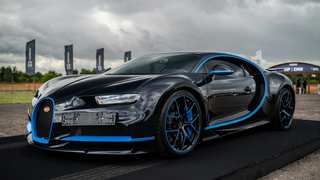
No discussion of horsepower milestones would be complete without acknowledging the automotive legend that is the Bugatti Veyron. While its successors have pushed the boundaries even further, with outputs exceeding 1,600 horsepower, the Veyron’s initial 1,000-horsepower milestone in 2005 was a seismic event in the automotive world. It signaled to every manufacturer that the pursuit of power had entered a new dimension.
The Veyron was more than just a car; it was a technological tour de force that pushed the Volkswagen Group to its engineering limits. The immense research and development costs associated with its creation were staggering, to the point where even the production of its successor, the Chiron (which utilized a heavily revised version of the same engine), likely struggled to recoup the initial investment.
At its heart lay an 8.0-liter, 16-cylinder engine—a configuration so outlandish it bordered on the absurd. Coupled with four turbochargers, this powerplant produced a seamless surge of power that redefined acceleration. The Veyron’s 1,000 horsepower, delivered through an advanced all-wheel-drive system, allowed it to achieve a top speed of 253 mph, a figure that seemed almost mythical at the time. It was a car that transcended its automotive purpose, becoming a symbol of engineering audacity and performance excess.
The 2004 BMW M5 (E60): The Power of Ten Cylinders
The BMW M5 has always been at the epicenter of the horsepower wars, particularly in its rivalry with Mercedes-AMG. This competition reached a fever pitch in 2004 with the introduction of the E60 generation. Departing from its predecessors’ turbocharged inline-six engines, BMW equipped the E60 M5 with a naturally aspirated 5.0-liter V10 engine.
This engineering decision was audacious. Instead of relying on forced induction, BMW added two cylinders and increased displacement, resulting in a power output of 507 horsepower—a full 100 horsepower more than the E39 M5 it replaced. The M5 E60 was a high-revving marvel, with a 7,750 rpm