The Horsepower Wars: How 14 Cars Redefined Performance
In today’s automotive landscape, horsepower and speed are often taken for granted. A supercar failing to deliver north of 600 horsepower feels underwhelming, while electric family cars routinely clock 0-60 mph sprints under four seconds—a feat once reserved for the most exclusive hypercars. This relentless march of progress, however, hasn’t been a straight line. It’s been a decades-long arms race, a “horsepower war” where manufacturers continuously one-up each other in the pursuit of ultimate power. The result? A world where 400-hp hot hatches, 600-hp luxury sedans, and 800-hp exotics are commonplace. But this evolution wasn’t without its watershed moments. Join us as we explore 14 cars that fundamentally reshaped the narrative of automotive performance, pushing the boundaries of what was thought possible.
The Icon of Subtlety: Lotus Carlton
Few vehicles embody the concept of a “sleeper” quite like the Lotus Carlton. So potent was its performance that its very legality was once debated in Parliament. While its aggressive body kit—featuring an assertive front splitter, flared arches, and a substantial rear wing—hinted at serious capability, it still underplayed the sheer ferocity lurking beneath the surface. Powering the Carlton was a Lotus-developed, twin-turbocharged 3.6-liter inline-six engine, unleashing a staggering 382 horsepower and enabling a top speed of 177 mph. In 1990, this was nothing short of breathtaking. For context, the contemporary BMW M5 produced 315 horsepower, and the Porsche 911 Turbo managed 320 horsepower. The Carlton wasn’t just fast; it was a statement, forcing the automotive world to confront a new echelon of performance. It asked a question that echoed through the industry: How much power is enough?
The Hot Hatch Benchmark: Ford Focus RS
The 1980s and 1990s saw the rise of the affordable performance hatchback, offering accessible thrills with outputs hovering around the 150-200 horsepower mark. Cars like the Golf GTI, Peugeot 205 GTI, and Renault Clio Williams brought driving enjoyment to the masses. But how did we get from there to today’s 400-horsepower behemoths? The journey involved several pivotal moments, one of the earliest and most significant being the 2002 Ford Focus RS. While the Escort Cosworth predated it with even higher power, it was a limited-run, all-wheel-drive homologation special. The Focus RS, on the other hand, set a new precedent for the decade-long horsepower war in the hot hatch segment. Its turbocharged 2.0-liter four-cylinder engine delivered 215 horsepower to the front wheels—the traditional configuration for a hot hatch. Crucially, Ford didn’t just bolt on more power; they upgraded the hardware, fitting a Quaife torque-vectoring differential to manage the output effectively. The RS was a polarizing machine, remembered for its raw, unfiltered character and its role in kickstarting a new era of performance expectations.
Engineering Excellence: Honda S2000
While the Honda S2000 might not top the charts for outright horsepower, its significance in the annals of power density is undeniable. The S2000’s 2.0-liter, dual-overhead-camshaft, four-cylinder F20C engine produced 250 horsepower and revved to a stratospheric 9,000 rpm. More impressively, it achieved a specific output of 125 horsepower per liter—a figure that, in 1999, was virtually unheard of. It wasn’t until the 2009 Ferrari 458 Italia and the 2013 Porsche 911 GT3 that this benchmark was surpassed. To this day, the S2000 remains firmly entrenched in the pantheon of naturally aspirated engines with the highest specific output, standing shoulder-to-shoulder with hypercars like the Ferrari LaFerrari, Porsche 918 Spyder, Gordon Murray Automotive T.50, and Aston Martin Valkyrie. This testament to Honda’s engineering prowess demonstrates that maximizing power isn’t solely the domain of forced induction or massive displacements.
The Luxury Powerhouse: Mercedes-Benz CL65 AMG
When the objective is raw, unadulterated power, nothing quite matches the combination of sheer displacement and forced induction. This philosophy perfectly encapsulates the Mercedes-Benz CL65 AMG. Introduced in 2003, this luxury coupe boasted a formidable 612 horsepower from its twin-turbocharged 6.0-liter V12 engine. At the time, it reigned supreme as the most powerful non-limited-production road car in the world. This level of performance rivaled that of contemporary supercars, and frankly, it was overwhelming. The car’s traction control system struggled valiantly to harness the immense power being sent to the rear wheels. The CL65 truly came alive at high speeds, delivering effortless, mountainous torque that allowed it to reel in distances with astonishing rapidity—a performance characteristic previously exclusive to the upper echelons of the automotive world.
The Hypercar Game-Changer: Bugatti Veyron
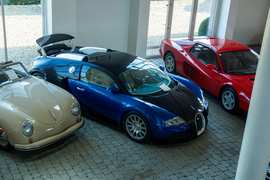
One simply cannot discuss the history of the horsepower wars without acknowledging the Bugatti Veyron. This automotive phenomenon elevated the pursuit of power to an unprecedented level. While its successors have since eclipsed its output, the Veyron’s original 1,000 horsepower (735 kW) in 2005 sent a clear and unambiguous message to every manufacturer: the rulebook had been torn up. The Veyron was a staggering feat of engineering that reportedly cost Volkswagen Group billions to develop—a sum that the subsequent Chiron, despite utilizing a derivative of the same engine, has arguably never fully recouped. Familiar though it may be, the Veyron’s configuration remains mesmerizing: an 8.0-liter, 16-cylinder engine with four turbochargers. It was, and in many ways still is, automotive insanity in its most beautiful form.
The M5’s Evolutionary Leap: BMW M5 (E60)
The BMW M5 has always been at the epicenter of the horsepower conflict. However, the rivalry between BMW and Mercedes-Benz to incrementally increase power levels reached a crescendo in 2004 with the introduction of the E60 generation. Eschewing forced induction for a high-revving, naturally aspirated 5.0-liter V10 engine, BMW achieved a remarkable feat. By simply adding cylinders and expanding displacement, they managed to extract 507 horsepower—a full 100 horsepower more than the E39 M5 it replaced. This was a substantial increase, but the number that truly stunned the industry was 507. For perspective, it took nearly 15 years for the M5 to gain another 100 horsepower, with the 2018 M5 Competition reaching 625 horsepower. The E60 M5’s introduction marked a pivotal moment where the performance sedan crossed a significant power threshold.
The Audi RS6’s Bold Statement
While BMW was making bold moves, Audi was preparing an even more audacious statement. The Audi RS6 C6 represented perhaps the most significant leap in power for the executive performance sedan segment. Although the Mercedes-AMG E63 of the era offered formidable power, the C6 RS 6 elevated the game dramatically. Launched in 2009, it featured a twin-turbocharged 5.2-liter V10 engine, producing a monumental 580 horsepower. This was an extraordinary figure for a production family car at the time, effectively marking the ceiling for naturally aspirated power in this class. Subsequent models have hovered around the 570-625 horsepower mark, with little deviation. The C6 RS 6 itself wasn’t universally praised; its two-ton weight and less-than-refined chassis dynamics drew criticism. Nevertheless, its impact on the horsepower race was undeniable. It served as a benchmark that other manufacturers would spend years trying to match, solidifying its legendary status despite its flaws.
American Muscle Redefined: Chevrolet Corvette ZR1 (C6)
The horsepower escalation wasn’t confined to European manufacturers. Across the Atlantic, Chevrolet was simultaneously pushing the boundaries of American muscle. The C6 Corvette Z06, with its 505-horsepower naturally aspirated V8, was already a formidable machine when it debuted in 2006. But in 2008, Chevrolet unleashed the Corvette ZR1 (C6). The venerable 7.0-liter LS7 V8 was replaced by a supercharged 6.2-liter LS9, catapulting the car’s output to a colossal 647 horsepower. This “Blue Devil” creation wasn’t just a domestic marvel; it sent shockwaves through Europe, setting Nürburgring lap records for production cars and outperforming established supercars in performance benchmarks. While the subsequent C7 ZR1 would eventually reach 765 horsepower, the C6 ZR1’s arrival was the moment when American performance truly intersected with the global supercar elite. At its launch, it was the most powerful non-limited-production car available worldwide, a true testament to American engineering prowess.
The Mustang’s Power Play: Ford Mustang Shelby GT500 (