The Pinnacle of Automotive Engineering: Revisiting the World’s Most Powerful Production Cars
The quest for automotive supremacy has always captivated gearheads and industry insiders alike. For decades, the horsepower wars raged silently in engine bays and design studios, culminating in a select group of production cars that pushed the boundaries of physics and engineering. While the landscape of high-performance vehicles has evolved dramatically since the mid-2010s, looking back at the era’s most powerful machines offers a fascinating glimpse into the evolution of automotive technology. This article revisits the titans of that period, analyzing their technical achievements, market impact, and the legacy they left on the industry.
Understanding the Metrics: What Defines “Production Car”?
Before diving into the specifics, it’s crucial to define what constitutes a “production car.” Unlike bespoke, coach-built vehicles or limited-run race prototypes, a production car must adhere to specific manufacturing criteria. Typically, this means the vehicle must be mass-produced—usually in quantities exceeding 30 units—and homologated for road use in at least one major market. This distinction is critical because it separates the realm of road-legal supercars from the even more extreme world of one-off concepts and track-only machines.
The Era of the Hybrid Hypercar
The mid-2010s marked a significant turning point in the hypercar segment, characterized by the emergence of gasoline-electric hybrids. This technological shift, driven by increasing environmental regulations and the desire for record-breaking performance, allowed manufacturers to combine the raw power of internal combustion engines with the instant torque of electric motors.
The Reigning Monarch: Bugatti Veyron 16.4 Super Sport
Topping the charts of its time was the Bugatti Veyron 16.4 Super Sport. More than just a car, the Veyron was a statement—a testament to what was possible when financial constraints were removed and engineering excellence was the sole focus. With its quad-turbocharged W16 engine, the Veyron produced a staggering 1,200 horsepower. This power was meticulously managed through a sophisticated all-wheel-drive system and a dual-clutch transmission, enabling the Veyron to achieve speeds previously unimaginable for road-legal vehicles.
The significance of the Veyron extended beyond its raw numbers. It redefined the hypercar segment, setting a benchmark for speed, luxury, and engineering complexity. Its production run, though limited, was substantial enough to qualify it as a true production car, solidifying its place in automotive history. The Veyron proved that extreme performance and road usability could coexist, paving the way for future generations of hypercars.
Ferrari’s Hybrid Masterpiece: The LaFerrari
Representing the pinnacle of Ferrari’s engineering prowess, the LaFerrari was a revolutionary machine that seamlessly integrated a V12 gasoline engine with an electric hybrid system. This combination delivered a combined output of 950 horsepower, allowing the LaFerrari to accelerate from 0 to 60 mph in under three seconds.
The LaFerrari was more than just a fast car; it was a rolling laboratory for Ferrari’s advanced technologies. The hybrid system, known as HY-KERS (Kinetic Energy Recovery System), was derived from Formula 1 technology and provided not only an immediate surge of torque but also improved fuel efficiency. The car’s aerodynamics were equally advanced, featuring active aerodynamic elements that adjusted in real-time to optimize downforce and minimize drag.
The LaFerrari’s impact on the industry was profound. It demonstrated that electrification was not a compromise but an enhancement for high-performance vehicles. Its success challenged traditional notions of supercar design and signaled a new era where sustainability and extreme performance could go hand in hand.
McLaren’s Electrifying Entry: The P1
The McLaren P1, produced by the legendary British marque, was another trailblazer in the hybrid hypercar revolution. With 903 horsepower generated from its V8 gasoline engine and electric motor combination, the P1 was a formidable competitor to the LaFerrari. What set the P1 apart was its focus on driver engagement and track performance.
McLaren’s heritage in Formula 1 heavily influenced the P1’s design and engineering. The car featured a lightweight carbon fiber monocoque chassis, ensuring exceptional rigidity and responsiveness. The active aerodynamics, including a deployable rear wing and air brakes, allowed the driver to fine-tune the car’s performance characteristics to suit track conditions.
The P1’s limited production run of 375 units ensured its exclusivity, but its impact was far-reaching. It showcased McLaren’s ability to compete at the highest level of the automotive industry and demonstrated the potential of hybrid technology to enhance driving dynamics. The P1 remains an iconic symbol of the hybrid hypercar era, celebrated for its blend of performance, technology, and driver focus.
Porsche’s Four-Wheel Drive Hybrid: The 918 Spyder
Porsche’s entry into the hybrid hypercar fray was the 918 Spyder, a technological marvel that combined a naturally aspirated V8 engine with two electric motors, one on each axle. This configuration provided the car with all-wheel drive and a combined output of 795 horsepower.
Unlike its Italian rivals, the 918 Spyder offered a unique blend of performance and practicality. It featured a removable roof panel, allowing for open-top motoring, and a sophisticated energy management system that optimized power delivery for different driving scenarios. The car’s performance was exceptional, with a 0-60 mph time of just 2.8 seconds and a top speed exceeding 210 mph.
The 918 Spyder’s significance lay in its demonstration of hybrid technology’s versatility. It proved that hybrid systems could be engineered for both efficiency and extreme performance, offering drivers the best of both worlds. The car’s success further validated the industry’s shift towards electrification and set a new benchmark for hybrid supercar performance.
The Natural Evolution: Ferrari F12 Berlinetta
Not all high-performance cars of this era relied on hybrid technology. The Ferrari F12 Berlinetta represented the traditional approach to supercar engineering, focusing on the raw power of a naturally aspirated V12 engine. With 730 horsepower, the F12 Berlinetta was the most powerful front-engined Ferrari ever built at the time of its release.
The F12 Berlinetta’s brilliance lay in its seamless integration of power and refinement. The V12 engine delivered its power in a smooth, linear fashion, providing an exhilarating driving experience without the abruptness sometimes associated with high-performance vehicles. The car’s aerodynamics were meticulously sculpted to optimize airflow and downforce, ensuring exceptional stability at high speeds.
While the F12 Berlinetta may have lacked the technological novelty of its hybrid counterparts, it represented the culmination of decades of Ferrari’s V12 engineering expertise. Its success demonstrated that traditional internal combustion engines still had a vital role to play in the high-performance segment, offering a purist’s driving experience that resonated with enthusiasts who valued engine sound and driver engagement.
The American Muscle Contender: Dodge Charger SRT Hellcat
The mid-2010s also witnessed the return of American muscle cars to the forefront of the performance landscape. The Dodge Charger SRT Hellcat, with its supercharged 6.2-liter V8 engine producing 707 horsepower, was a game-changer. It offered supercar-level performance in a practical four-door sedan package, challenging the dominance of European manufacturers.
The Hellcat’s significance lay in its accessibility. While it possessed the power to rival exotic supercars, it was priced within reach of a broader segment of the market. This democratic approach to performance made high horsepower more attainable than ever before, inspiring a new generation of performance enthusiasts. The Hellcat also demonstrated that American manufacturers could compete on the global stage in terms of engineering and performance.
Lamborghini’s V12 Powerhouse: The Aventador LP700-4
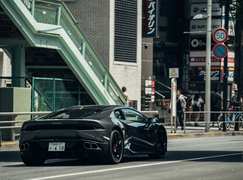
Lamborghini, always synonymous with dramatic design and extreme performance, continued its tradition with the Aventador LP700-4. Powered by a naturally aspirated V12 engine producing 690 horsepower, the Aventador was a masterpiece of automotive theater. Its angular design, scissor doors, and roaring exhaust note made it one of the most visually striking cars of its time.
While the Aventador’s power output may have been slightly lower than some of its contemporaries, its performance was nonetheless extraordinary. With a 0-60 mph time of just 2.9 seconds and a top speed exceeding 217 mph, it offered a visceral driving experience that was both thrilling and unforgettable. The Aventador represented the pinnacle of traditional supercar engineering, demonstrating that there was still room for naturally aspirated V12 engines in the high-performance segment.
Ferrari’s Versatile Grand Tourer: The FF
Ferrari’s commitment to innovation extended beyond track-focused hypercars. The Ferrari FF, introduced in 2011, was a groundbreaking vehicle that combined supercar performance with everyday usability. With seating for four and ample luggage space, the FF was designed as a grand tourer for the discerning enthusiast who desired both performance and practicality.
The FF’s most significant innovation was its all-wheel-drive system, a first for Ferrari. This system, combined with the car’s powerful V12 engine, provided exceptional traction and stability in all weather conditions. The FF demonstrated that Ferrari could successfully integrate new technologies while maintaining its core brand identity. Its success paved the way for future generations of versatile Ferrari models.
McLaren’s Lightweight Contender: The 650S
Following the success of the P1, McLaren introduced the 650S,