2025’s Definitive Ranking: Unveiling the Top 10 Most Powerful Cars in the World
The automotive landscape is currently experiencing a seismic shift, unlike anything the industry has witnessed in its 130-year history. While gasoline-powered hypercars continue to push the boundaries of internal combustion, the electrification revolution has thrown down a gauntlet that has forced even the most storied marques to rethink their entire engineering philosophy. We are living in an era where the definition of “power” is being rewritten daily, not just in terms of raw horsepower figures, but in the seamless integration of electric torque, advanced aerodynamics, and sustainable materials.
For the past decade, enthusiasts and industry analysts have debated the apex predator of the automotive world. But as we navigate 2025, the conversation has evolved beyond a simple horsepower war. It is now a complex dialogue about how manufacturers are balancing extreme performance with real-world usability, technological innovation, and environmental responsibility. The most powerful cars on the planet today are no longer just expensive toys for the ultra-wealthy; they are rolling laboratories, showcasing the bleeding edge of what is possible when engineering, design, and technology converge without compromise.
In this definitive guide, we will embark on a comprehensive journey through the pantheon of automotive excellence. We will dissect the specifications, analyze the engineering marvels, and explore the unique driving dynamics of the machines that have redefined the limits of performance. From the mind-bending output of bespoke hypercars to the electrifying acceleration of mass-produced EVs, this is your essential roadmap to the most powerful cars that are defining the future of speed.
The Evolution of Automotive Power: From Combustion Kings to Electric Titans
To fully appreciate the significance of the current horsepower hierarchy, we must first understand the historical context of the automotive performance race. For the better part of the 20th century, the quest for ultimate power was dominated by the internal combustion engine (ICE). This was an era defined by brute force, where engineers sought to extract every last ounce of energy from gasoline, often through forced induction—turbocharging and supercharging—to create the legendary muscle cars and supercars of their time.
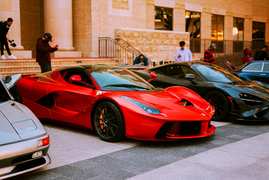
However, the dawn of the 21st century brought with it a paradigm shift. The rise of hybrid technology, spearheaded by pioneers like Ferrari with the LaFerrari and McLaren with the P1, proved that electric motors could be integrated with gasoline engines to produce unprecedented levels of power and efficiency. These early hybrids were not just about saving fuel; they were about using electric torque to eliminate turbo lag and provide instant acceleration, creating a driving experience that was previously unattainable.
Yet, the true disruptor in this evolution has been the full-scale electrification movement. Companies like Tesla, initially dismissed by the traditional automotive establishment, demonstrated that electric powertrains could deliver superior acceleration and performance characteristics compared to their gasoline counterparts. This forced the entire industry to pivot, leading to the current landscape where even the most traditional supercar manufacturers are investing heavily in electric vehicle (EV) technology.
Today, the most powerful cars in the world are a testament to this convergence of technologies. We see hybrid systems that combine the visceral roar of a V12 engine with the instant torque of electric motors. We also see all-electric hypercars that deliver horsepower figures that were once relegated to the realm of science fiction. This diversification of power sources is what makes the 2025 ranking so fascinating—it is a reflection of an industry in transition, where the past, present, and future of automotive engineering are all competing for the top spot.
The 2025 Horsepower Hierarchy: A Definitive Ranking of the World’s Most Powerful Cars
The following list represents the pinnacle of automotive engineering as of 2025. These vehicles are not just fast; they are technological marvels that push the boundaries of what is physically possible on four wheels. It is important to note that while some of these cars are production models available for purchase (albeit in extremely limited numbers), others remain concept vehicles or bespoke creations that may never reach the public. Regardless of their availability, they all represent the zenith of automotive power.
Devel Sixteen: The 5,000 HP Anomaly
Horsepower: 5,007 hp
Engine: 12.3L Quad-Turbo V16
Transmission: 8-Speed Automatic (Est.)
0-60 mph: Estimated under 2.0 seconds
Top Speed: 350+ mph (Claimed)
The Devel Sixteen remains an enigma in the automotive world, a testament to the human drive to push beyond all known limits. When it was first unveiled, its claimed horsepower figure of 5,007 hp seemed like a typographical error. Yet, through years of development and several prototypes, the Turkish manufacturer has managed to create a machine that, while perhaps not reaching the advertised output in its current form, remains the undisputed king of raw horsepower.
What truly sets the Sixteen apart is its bespoke, quad-turbocharged V16 engine—a powerplant that dwarfs anything found in even the most exotic Bugattis or Koenigseggs. This engine is not just about brute force; it is an engineering marvel in itself, featuring custom-forged internals and a cooling system capable of handling the immense heat generated by sixteen cylinders firing in rapid succession.
While the Sixteen’s top speed claims remain unverified by independent testing, its acceleration figures are nothing short of astronomical. In a world where sub-2-second 0-60 mph times are becoming increasingly common among electric hypercars, the Sixteen’s ability to deliver such performance from a gasoline engine is a remarkable feat. It represents the absolute pinnacle of internal combustion technology, a final hurrah for the V16 engine before it potentially fades into automotive history.
Koenigsegg Gemera: The 2,300 HP Grand Tourer
Horsepower: 2,300 hp (with E85 biofuel)
Engine: 5.0L Twin-Turbo V8 + 3 Electric Motors
Transmission: 9-Speed Light Speed Tourbillon (LST)
0-60 mph: 1.9 seconds
Top Speed: 249+ mph (Electronically Limited)
Koenigsegg has long been synonymous with pushing the boundaries of automotive performance, and the Gemera is perhaps their most audacious creation yet. Dubbed a “Mega-GT,” the Gemera redefines the concept of a grand tourer by blending the practicality of a four-seater with the performance of a hypercar.
The secret to the Gemera’s incredible power lies in its innovative powertrain. It features a compact, 5.0-liter twin-turbocharged V8 engine that produces a staggering 1,400 hp on its own. This is supplemented by three electric motors—one for each rear wheel and one for the crankshaft—which together provide an additional 900 hp. When fueled with E85 biofuel, the combined output reaches an astonishing 2,300 hp.
What makes the Gemera truly revolutionary is its transmission. The proprietary Light Speed Tourbillon transmission is a testament to Koenigsegg’s engineering prowess, offering seamless gear changes and an incredibly compact design that allows for the accommodation of four seats and luggage space. This combination of extreme power and everyday usability is what positions the Gemera as one of the most significant vehicles of the decade.
Lotus Evija: The 2,000+ HP All-Electric Hypercar
Horsepower: 2,011 hp
Engine: 4 Electric Motors (One per wheel)
Transmission: Single-Speed Automatic
0-60 mph: Under 2.0 seconds
Top Speed: 200+ mph
The Lotus Evija marks a new era for the legendary British brand, signaling its complete transition to electrification. This all-electric hypercar is not just a statement piece; it is a testament to Lotus’s commitment to performance engineering, demonstrating that electric vehicles can deliver the handling dynamics and driving engagement that the brand is famous for.
The Evija’s power comes from a revolutionary quad-motor setup, with each motor driving a separate wheel. This allows for advanced torque vectoring, enabling the car to precisely distribute power to each tire for optimal grip and handling. The combined output of these motors results in a staggering 2,011 horsepower and over 1,700 lb-ft of torque, making it one of the most powerful production cars ever created.
Beyond its raw power figures, the Evija’s design is a masterpiece of aerodynamic engineering. Its sculpted bodywork channels air through the car’s structure, creating downforce while maintaining a low drag coefficient. This combination of electric power and Lotus’s legendary chassis expertise results in a driving experience that is both exhilarating and refined.
Rimac Nevera: The Electric Hypercar Record Breaker
Horsepower: 1,914 hp
Engine: 4 Electric Motors
Transmission: Single-Speed Automatic
0-60 mph: 1.74 seconds (World Record)
Top Speed: 258 mph
The Rimac Nevera has firmly established itself as the benchmark for electric hypercars. Developed by the Croatian automotive innovator Mate Rimac, the Nevera is a testament to the potential of electric propulsion, combining breathtaking performance with advanced technology and luxury appointments.
What makes the Nevera stand out is its incredible acceleration. In 2022, it set a Guinness World Record for the fastest accelerating production car, achieving 0-60 mph in a mind-bending 1.74 seconds. This record was set