The 10 Most Powerful Production Cars on the Planet in 2025: From 1,000-HP Hybrids to 2,000-HP Hyper-EVs
For decades, automotive excellence was primarily measured by top speed. Reaching stratospheric velocities like the 240 mph barrier was the ultimate benchmark of engineering prowess. However, as global emissions regulations tighten and battery technology rapidly advances, the metric of performance has undergone a dramatic transformation. Today, the true measure of a road-legal machine’s capability lies not in how fast it can theoretically go, but in its absolute horsepower output.
We are living in an unprecedented era of automotive engineering where psychological barriers have been shattered. The once unthinkable 1,000-horsepower threshold has become the new baseline for hypercar manufacturers. Innovations such as jet-sized turbochargers, sophisticated torque-fill hybrid systems, and high-voltage 800-volt battery architectures have pushed engine outputs well beyond what was previously thought possible for road-legal vehicles.
This list delves into the most extreme, jaw-dropping machines currently available for purchase by the public. These are not concept cars or track-only experiments; they are street-legal marvels of engineering that turn every application of the throttle into an experience bordering on aerospace dynamics. From the visceral howl of 11,000 RPM V12 engines to the silent, brutal shove of electric powertrains, these vehicles represent the absolute zenith of the automotive industry in 2025.
Here, in ascending order, are the ten production cars with the highest horsepower figures on the planet. Prepare to have your perception of “fast” redefined.
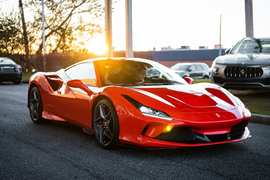
Ferrari SF90 XX Stradale — 1,030 hp
Maranello, the legendary home of the Prancing Horse, opens this elite list with a significant milestone: its first street-legal “XX” model. Building upon the revolutionary foundation of the standard SF90 Stradale—the first full-hybrid Ferrari—the XX variant pushes the boundaries of performance even further.
At its heart lies the familiar 4.0-litre twin-turbocharged V8 engine, a masterpiece of internal combustion engineering that produces a staggering 797 horsepower on its own. However, the true genius of the SF90 XX lies in its sophisticated hybrid system. Three electric motors—one integrated into the gearbox and two on the front axle—combine to deliver an additional 233 horsepower. When these power sources unite, they unleash a colossal 1,030 horsepower.
This immense output is channeled through an advanced all-wheel-drive system that can vector torque to individual wheels with millisecond precision, ensuring maximum traction during hard acceleration. The performance figures are nothing short of breathtaking. The SF90 XX rockets from 0 to 62 mph (0-100 km/h) in a mere 2.3 seconds, and covers the 0-124 mph (0-200 km/h) sprint in just 6.7 seconds. These are figures that rival the world’s fastest dragsters.
Visually, the SF90 XX is a departure from its road-focused siblings. It features a fixed carbon fiber roof, a dramatic swan-neck rear wing that generates significant downforce, and extensive aerodynamic enhancements sculpted from carbon fiber. These aero elements are not merely for show; they are functional components designed to keep the car glued to the tarmac during high-speed cornering.
Despite its extreme performance orientation, the SF90 XX remains a road-legal production car, albeit one produced in very limited numbers. It represents Ferrari’s boldest statement yet on the future of high-performance hybrids, proving that electrification can coexist with the visceral thrill of a combustion engine. For drivers seeking the pinnacle of Ferrari performance with a clear nod to their track-bred heritage, the SF90 XX is the ultimate expression of Maranello’s engineering might.
Aston Martin Valkyrie — 1,160 hp
The Aston Martin Valkyrie is not merely a car; it is a rolling testament to the vision of Adrian Newey, the legendary Formula 1 aerodynamicist. Developed in collaboration with Cosworth, the Valkyrie represents the closest thing to a road-legal F1 car that money can buy.
The centerpiece of this automotive marvel is a naturally aspirated 6.5-litre V12 engine. In an age of turbocharging and electrification, Aston Martin chose the purity and responsiveness of a high-revving V12. This extraordinary engine spins to a stratospheric 11,100 RPM redline, producing a spine-tingling soundtrack that echoes the glory days of Le Mans prototypes. In its standard configuration, the V12 alone generates 1,000 horsepower.
However, the Valkyrie is a hybrid. It incorporates a 160-horsepower electric motor integrated into its lightweight transmission. When combined with the V12, the total system output reaches an astounding 1,160 horsepower. This power is delivered with an immediacy and linearity that only a naturally aspirated engine can provide, augmented by the instant torque fill of the electric motor.
The Valkyrie’s aerodynamic design is nothing short of breathtaking. Newey’s team sculpted the bodywork to generate an incredible 1,100 kilograms (nearly 2,425 pounds) of downforce at just 240 km/h (150 mph). This aerodynamic mastery is achieved through massive underbody tunnels that channel air from the front of the car, through the cockpit area, and out through the rear, creating a ground-effect vacuum that sucks the car to the road.
The chassis is a marvel of lightweight engineering. Constructed almost entirely from carbon fiber, the Valkyrie weighs in at a mere 1,270 kilograms (2,800 pounds). This exceptional power-to-weight ratio allows the car to achieve performance metrics that defy belief.
The interior is an experience in itself, eschewing traditional luxury for a function-first approach. Drivers sit in a reclined, feet-up position reminiscent of Le Mans prototypes, with their backs against the rear axle for optimal weight distribution. The steering wheel is a yoke-style unit, directly inspired by Formula 1, featuring integrated displays and controls.
Driving the Valkyrie is not simply driving; it is a visceral, all-encompassing experience. Every gear change, every corner, every surge of acceleration connects the driver directly to the machine in a way that few cars can match. It is a pure, unfiltered expression of performance engineering, a true automotive icon for the 21st century.
Koenigsegg Jesko — 1,280 hp
From the mind of Christian von Koenigsegg comes the Jesko, a hypercar that pushes the boundaries of what is technically possible in the automotive world. Named after the founder’s father, the Jesko is the culmination of decades of innovation from the Swedish manufacturer.
At the heart of the Jesko lies a 5.0-litre twin-turbocharged V8 engine, but this is no ordinary engine. It features a revolutionary 12-kilogram flat-plane crankshaft, the lightest production crankshaft of its kind, allowing for lightning-fast rev changes. The engine is also equipped with cutting-edge anti-lag technology utilizing an electric compressor, which eliminates turbo lag entirely and ensures instant throttle response.
When fueled with standard pump gasoline, the Jesko produces a formidable 1,280 horsepower. However, when fed with E85 biofuel, the engine’s output surges to an astonishing 1,600 horsepower. This dual-fuel capability provides drivers with a choice between the visceral thrill of a high-performance V8 and the mind-bending power of a near-unlimited output machine.
The Jesko’s transmission is a work of engineering art. Dubbed the “Light-Speed Transmission,” it is a revolutionary nine-speed gearbox that shifts in an astonishing 20 milliseconds, faster than the blink of an eye. It utilizes a unique design with no traditional synchros, relying instead on precise electronic control and mechanical engagement to deliver gear changes with unprecedented speed and smoothness.
Aerodynamics play a crucial role in the Jesko’s performance. The High-Downforce variant features a massive rear wing that generates 1,400 kilograms (over 3,000 pounds) of downforce at 275 km/h (170 mph), ensuring the car remains planted during high-speed cornering. For those seeking ultimate top speed, the Jesko Absolut variant features a more streamlined design with a smaller wing, targeting a theoretical top speed of 500 km/h (310 mph).
The interior of the Jesko is a blend of futuristic design and functional ergonomics. The driver-focused cockpit features a digital instrument cluster that rotates to always present the most relevant information to the driver, whether in normal or track mode. Premium materials such as carbon fiber, Alcantara, and polished aluminum are used throughout, creating an atmosphere of exclusivity and performance.
The Koenigsegg Jesko represents the pinnacle of Swedish engineering ingenuity. It combines raw power, groundbreaking technology, and aerodynamic brilliance to create a machine that redefines the limits of performance. For the discerning collector seeking a car that is both a technological marvel and a visceral driving experience, the Jesko stands in a class of its own.
Koenigsegg Regera — 1,500 hp
From the same Swedish visionary behind the Jesko, the Koenigsegg Regera represents a different philosophy of hypercar design. While the Jesko is built for outright track performance, the Regera focuses on a unique blend