14 Cars That Ignited the Horsepower Wars
We now take horsepower and speed for granted. Any supercar is barely worth its asking price if it’s making less than 600 horsepower (441kW). Likewise, many performance-oriented electric family cars can accelerate from 0-62mph in less than four seconds, while, in the past, achieving a sub-four-second time was reserved for only the most advanced and exclusive supercars. The march of progress is relentless, and, in fact, has been for a considerable amount of time, as evidenced by what is known as the ‘horsepower wars’. This is a race between manufacturers over the years for the last thirty years, primarily to outdo their rivals’ performance models in terms of power. The result is that we live in a world of 400hp (294kW) performance hatchbacks, 600hp (441kW) luxury saloons and 800hp (588kW) hypercars, but there have been a few significant turning points along the way. We’ve decided to list them, though only a few luxury models really stand out in terms of outright power.
Lotus Carlton
So potent and fast was its outright power that the legality of it was debated in Parliament. The Lotus Carlton probably defined the concept of the ‘sleeper’ – a car that was understated for the performance it actually delivered. It wasn’t exactly subtle, with a bulging front bumper, stubby wheel arches and a firm spoiler, but even that modest show of aggression couldn’t give us a clue as to the potential power lurking beneath the bonnet. The twin-turbocharged 3.6-litre straight-six engine, developed by Lotus, produced a colossal 382hp (280 kW) and propelled the Carlton to a top speed of 177mph (280 km/h).
In 1990, when the contemporary BMW M5 and Porsche 911 Turbo produced 315hp (231 kW) and 320hp (235 kW) respectively, that was terrifying speed and power. Really, this was the first time that we had to ask ourselves, is that actually enough?
Ford Focus RS
Back in the 1980s and 1990s, performance hatchbacks were making numbers starting with a 1 and with a 2 tacked on the end, and we were incredibly grateful for it. The Golf GTI, 205 GTI, Clio Williams and many more besides delivered genuine performance to the people. So how on earth did they end up doubling their output in the space of 30 years? Slowly, although there have been some key moments, one of which was the 2002 Ford Focus RS. Okay, so the Escort Cosworth was more powerful, but that was a four-wheel-drive special that really had no rivals or counterparts. The Focus, on the other hand, set a precedent for the horsepower wars between performance hatchbacks that would last for the next decade, with its 215hp (158 kW) turbocharged four-cylinder engine, sending power exclusively to the front wheels, just as a traditional performance hatchback should. It also upped the ante in terms of specification along with the power output, adding a Quaife torque-biasing differential to help tame the power. The RS was a controversial car, remembered for its raw, uncompromising character.
Honda S2000
The Honda S2000 doesn’t stand out in terms of outright power but it was a very significant car in the history of horsepower production. Its 2.0-litre, dual-overhead-cam, straight-six F20C engine produced 250hp (183 kW) and could rev to 9,000 rpm. More importantly, it produced 125hp (91 kW) per litre… in 1999. That’s a figure that would only be surpassed by the 2009 Ferrari 458 Italia and would only be matched by the 2013 Porsche 911 GT3. It still holds its own in the list of cars with the highest power output per litre using naturally aspirated engines, with the likes of the Ferrari LaFerrari, Porsche 918 Spyder, GMA T.50 and Aston Martin Valkyrie also featuring.
Mercedes-Benz CL65 AMG
But when you want proper power, nothing beats displacement… combined with a powerful turbocharger. That’s why the Mercedes-Benz CL65 AMG could boast a colossal 612hp (450 kW) as far back as 2003, thanks to its 6.0-litre twin-turbo V12 engine. It was easily the most powerful (non-limited production) series-production car in the world. This was supercar-rivalling power at the time and, frankly, it was too much, as evidenced by the struggle of the traction control system every time you tried to put all that power down through the rear wheels. It performed best when on the move at high speed, accelerating from 70 mph to 140 mph with the sort of ferocity that any performance car shows when it’s already doing 70 mph.
Bugatti Veyron
We couldn’t really leave this one out, could we? The Bugatti Veyron was always the pinnacle of outright engine power. While its successors have surpassed the 1,600hp (1,176 kW) mark, the Veyron’s 1,000hp (735 kW) from 2005 was still a massive statement and a signal to all performance manufacturers that, when it came to power, anything was possible. A monumental engineering feat that cost the VW Group a small fortune, it’s probably fair to say that even the production of the Chiron (which, admittedly, used a developed version of that engine) won’t recoup the costs. You’ve seen it thousands of times but it still doesn’t lose its madness: 8.0-litre, 16-cylinder, four turbochargers. Mental.
BMW M5
The BMW M5 has always been at the heart of what we generally refer to as the ‘horsepower wars’. But the race between it and Mercedes to increase power with each generation reached fever pitch in 2004, when BMW unleashed the E60. It possessed a mighty 5.0-litre naturally aspirated V10 engine, with the displacement not increasing, but two cylinders were added and, staggeringly, 100hp more than the E39 it replaced. That was a significant increase, but the most impressive figure was this: 507hp (372 kW). To put that into perspective, it took nearly 15 years for the M5 to add another 100hp (73 kW) like the E60 did with the E39, with the arrival of the 2018 M5 Competition at 625hp (459 kW).
Audi RS6
However, the biggest leap on the road to the new M5 was actually the Audi RS 6 C6. While the Mercedes-AMG E63 had put up a pretty good fight, it was Audi that landed the knockout blow. Arriving in 2009, the C6 RS 6 possessed a 5.2-litre twin-turbocharged V10, producing no less than 580hp – a phenomenal figure at the time for a family car. This was the final leap in power in the executive saloon segment, at least where combustion engines were concerned. All models that have arrived since have topped out between 570-625hp (419-459 kW) and not much more. The C6 RS 6 wasn’t a particularly good car, given its two-tonne weight and underwhelming chassis, but it was certainly a legend of the horsepower wars.
Corvette ZR1
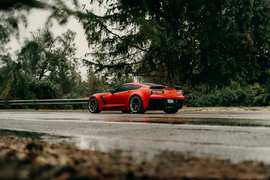
It wasn’t just the German performance gurus pushing the envelope with power, and how could we put together a list of ‘horsepower heroes’ without mentioning our friends across the pond? We thought the C6 Corvette Z06, with 505hp (371 kW), was a monster when it arrived in 2006. Then, in 2008, the Corvette ZR1 appeared. The 7.0-litre naturally aspirated LS7 V8 was replaced by a 6.2-litre supercharged LS9, giving a colossal 647hp (475 kW). The ‘Blue Devil’ Corvette crossed the pond and made waves in Europe, setting Nürburgring lap records for production cars and beating supercar rivals in performance tests. Sure, the C7 ZR1 also made 765hp (562 kW) but, at the time of its launch, you could buy a more powerful Dodge Challenger.
At the time, the C6 was the most powerful (non-limited production) production car on sale in the world.
Ford Mustang Shelby GT500
Ford wasn’t about to take that lying down, of course. How did they respond? By fitting the Mustang with more power than the supercar next door, with a solid rear axle to boot. The 2013 Mustang GT500 possessed 671hp (493 kW), using the special 5.8-litre Trinity V8 engine – a unit unique within the Ford group.